
What Did People Do Before Glasses? The Secret History of Ancient Eyesight
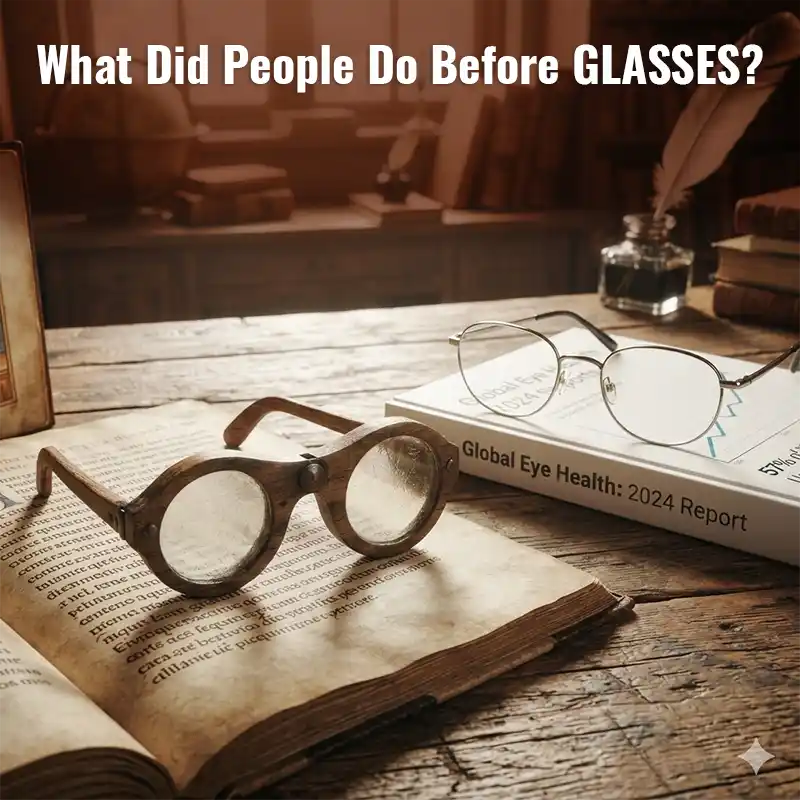
Have you ever misplaced your glasses and felt completely lost trying to find your phone or keys? It is a scary feeling. Today, millions of people cannot even get out of bed safely without putting on contacts or reaching for their spectacles. We live in a world where sharp vision is everything. We read tiny text on screens all day, look at distant road signs while driving cars, and work on detailed computer spreadsheets for hours.
Disclaimer
But have you ever stopped to wonder what did people do before glasses were invented?
Think about it. Wearable eyeglasses did not pop up until the late 13th century in Italy. Even then, they were rare, expensive, and mostly designed for old scholars who struggled to read books up close. For thousands of years of human history, from ancient cave dwellers to mighty empires, people had to survive, hunt, build empires, and fight wars with whatever eyesight they were born with.
If you had terrible vision in the ancient world, you could not just book an eye exam or get a quick laser surgery. So, what did people do before glasses became a common household item? How did they manage to live normal lives?
The answer is fascinating. It turns out that ancient humans lived in a completely different environment that actually protected their eyes. When things did go blurry, they used clever tricks, natural tools, and deep community support to get by. Let’s dive deep into the secret history of ancient eyesight and look at how our ancestors saw the world.
Table of Contents
ToggleWhen Was Glasses First Used and In What Type?
Spectacles were first invented and used in northern Italy during the late 13th century, right around the year 1286.
The First Type: Glasses That Balanced on Your Nose
The very first type of eyewear did not have the side arms that hook over your ears. Instead, they were called rivet spectacles.
To make them, craftsmen took two separate round magnifying lenses made of polished stone or hand-ground glass. They set these lenses into round frames made of wood, animal horn, or bone. Then, they pinned the ends of the two frames together in the middle using a metal rivet.
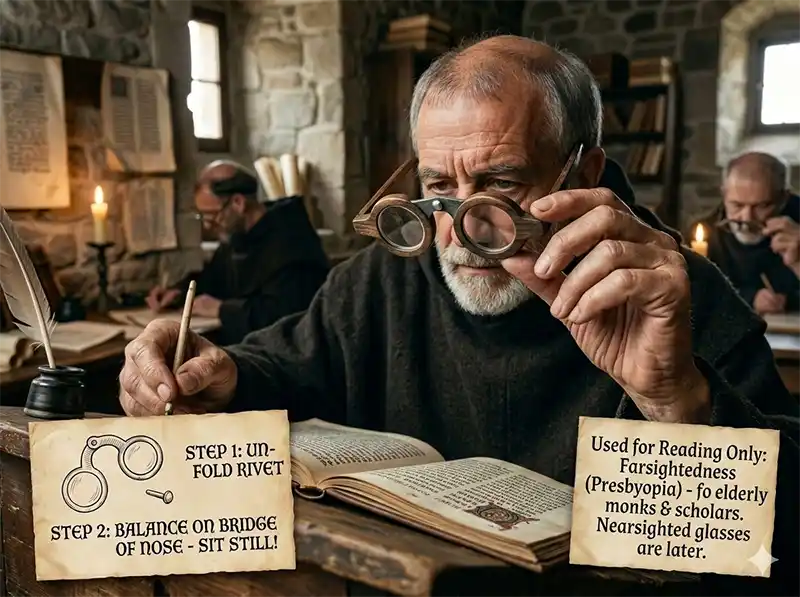
To use them, you had to manually clamp the frames onto the bridge of your nose and sit completely still. If you moved your head too fast, they would fall right off! Some people preferred to just hold them up in front of their eyes with their hands while reading.
They Were Only for Reading
These early lenses could only fix one specific vision problem: farsightedness. This is the natural loss of close-up vision that happens to people as they grow old. Because of this, these early glasses were only used as reading aids by elderly monks, rich merchants, and scholars. Glasses to help nearsighted people see far away objects were not invented until much later.
When Did Glasses Become Common for Everyone?
Eyeglasses did not become a common household item overnight. It took two major historical events to make them popular across the globe:
1. The Printing Press (1440s)
Before the mid-1400s, books were rare because they had to be written out completely by hand. Very few people knew how to read, so nobody really cared if their vision was a little blurry. But when the printing press was invented, books and newspapers were suddenly everywhere. As regular people started learning to read, millions of them suddenly realized they could not see the tiny text. This created a massive demand for cheap reading glasses.
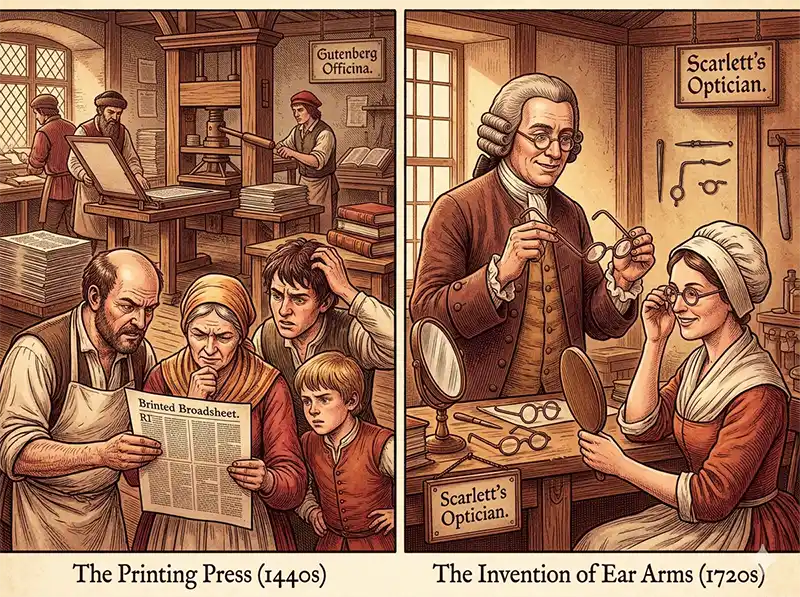
2. The Invention of Ear Arms (1720s)
Glasses were still very annoying to wear because they kept slipping off the nose. That changed in the 1720s when a British optician named Edward Scarlett added side arms that securely hook over the ears. This single invention made glasses comfortable enough to wear all day long while working or walking.
How Many Percent of People Use Glasses Today?
Today, a massive number of humans rely on eyewear. Across the entire world, about 57% of the total human population uses prescription glasses. That means roughly 4.5 billion people need a pair of spectacles to see clearly every single day.
The Difference Between Countries
While the world average is 57%, the actual number of people wearing glasses changes a lot depending on where you live:
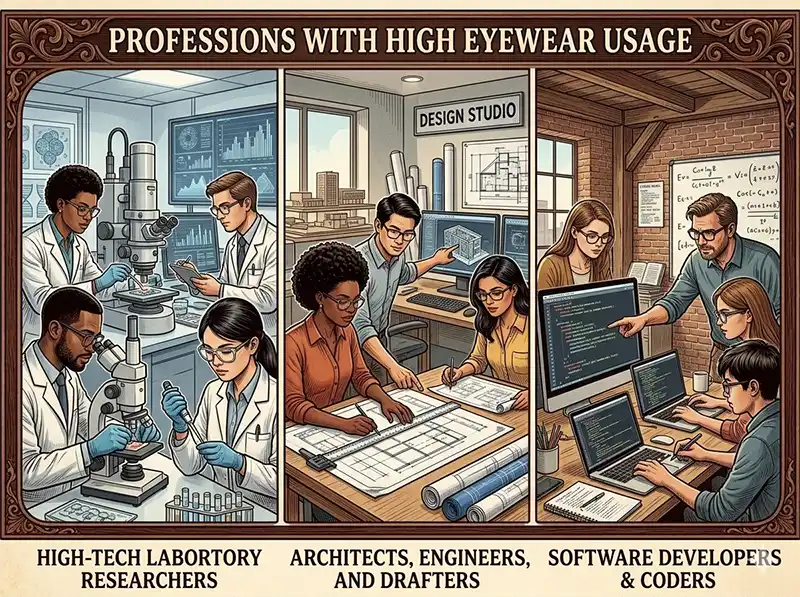
- Rich Countries (60% to 80%): In places with modern tech and regular eye clinics, the numbers are very high. For example, about 74% of people in Japan wear glasses, and around 64% of adults in the United States use them. Because children in these countries spend so much time indoors looking at phones and computer screens, eye strain is very common.
- Developing Countries (14% to 35%): In poorer regions, the percentage drops drastically. In India, only about 35% of people wear glasses, and in parts of Africa, it drops to less than 15%.
This low number does not mean people in these regions have perfect eyes. It actually means that millions of adults and children have blurry vision but simply cannot afford to buy a basic pair of spectacles.
Ancient Humans Had Excellent Vision?
To understand what did people do before glasses, we first have to bust a huge modern myth. We assume that because millions of people need glasses today, millions of people must have needed them back then. That is actually false.
Why Myopia is a Modern Problem?
Nearsightedness, which doctors call myopia, is largely a modern epidemic. In the ancient world, very few people suffered from blurry distance vision. Our eyes are highly adaptable organs. When children grow up, their eyeballs develop based on how they use them.
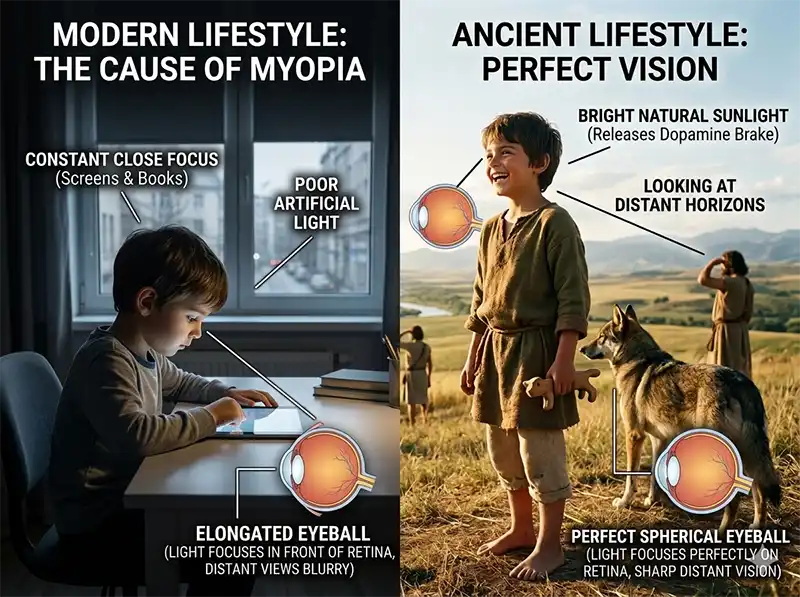
Nowadays, young kids grow up mostly indoors. They spend hours looking at tablets, playing video games, and reading under poor artificial lights.This constant close-up focus strains the eye muscles. It causes the eyeball to stretch out and elongate over time. When an eyeball becomes too long from front to back, light cannot focus perfectly on the retina. It falls short, making distant objects look like a blurry smudge.
In ancient times, life happened entirely outdoors. Children were not trapped inside rooms staring at glowing screens. They were running around fields, looking at distant horizons, and tracking animals.
Our eyes need bright, natural sunlight to grow correctly. Natural sunlight helps special cells inside your eyes release a brain chemical called dopamine.This natural dopamine acts like a biological brake. It stops the eyeball from stretching out of shape during childhood. Because ancient people spent almost all their time under the sun, their eyes naturally grew into perfect, healthy spheres. They simply did not have the near-sighted vision issues that plague our modern world.
[WordPress Block: Heading 2]
Clever Physical Tricks to Force Better Focus
Of course, not everyone had perfect vision. Some people were born with genetic eye defects, and almost everyone developed blurry vision as they grew old. When an ancient hunter or elder noticed their vision slipping, they had to rely on quick physical hacks to bend light to their will.
[WordPress Block: Heading 3]
The Magic of the Pinhole Effect
If you want to experience exactly what did people do before glasses, try this simple test right now. Take off your glasses, close one eye, and make a tiny, tight fist with your hand until there is only a microscopic pinhole gap between your fingers. Peer through that tiny hole at a distant blurry object. You will notice that the object suddenly looks much sharper.
This is called the pinhole effect, and it is a basic law of physics. When your vision is blurry, it is because your eye lens is letting in too much scattered light from the sides. Squinting tightly or looking through a tiny gap blocks those scattered, peripheral light rays. It forces a single, sharp, concentrated beam of light to pass straight through the center of your pupil. Ancient people used this trick constantly. They squinted, peeped through narrow gaps in woven baskets, or used pierced pieces of bone to instantly sharpen their surroundings.
[WordPress Block: Heading 3]
Inuit Snow Goggles: The Earliest Eye Wear
Long before Europeans invented glass spectacles, the Inuit people living in the harsh, blinding environments of the Arctic came up with a brilliant invention. They did not have glass lenses, but they suffered from intense snow blindness caused by sunlight reflecting off white ice.
To solve this, they carved goggles out of caribou antler, driftwood, or walrus ivory. Instead of glass, they carved thin, narrow horizontal slits across the front. These goggles did two things at once:
- They protected the eyes from the blinding glare of the sun.
- They acted as a permanent pinhole lens, instantly sharpening the hunter’s distance vision so they could spot seals and polar bears miles away.
[WordPress Block: Heading 2]
Famous Historical Figures Who Struggled with Sight
When we read history textbooks, we see grand stories of rulers and philosophers, but we rarely read about their physical struggles. Looking at specific historical leaders gives us a brilliant picture of what did people do before glasses to maintain power and respect.
[WordPress Block: Heading 3]
Emperor Nero and His Emerald Mirror
The Roman Emperor Nero ruled during the 1st century AD. He was famous for his grand lifestyle and his love for watching violent gladiatorial games in massive open-air arenas. However, historical accounts from the writer Pliny the Elder reveal that Nero had very weak, strained eyes. He struggled to see distant actions clearly, especially under the burning Italian sun.
To fix this, Nero had his servants find a large, high-quality emerald gemstone. He had jewelers polish the emerald until it was smooth, flat, and thin. When Nero sat in his royal box at the arena, he would hold this green emerald up to his eye and look through it. The green tint of the gemstone acted like an ancient pair of sunglasses, cutting down the blinding glare of the arena floor. Furthermore, the natural curve of the polished crystal provided a tiny bit of magnification, helping the emperor track the movements of the gladiators.
[WordPress Block: Heading 3]
Cicero and the Burden of Aging Eyes
Marcus Tullius Cicero was one of ancient Rome’s greatest politicians, lawyers, and writers. He spent his entire life reading thousands of handwritten philosophy scrolls and writing long legal speeches. But as Cicero grew older, his eyes naturally succumbed to presbyopia—the age-related loss of close-up vision.
Cicero found this incredibly frustrating. In his personal letters, he complained bitterly about getting old. He wrote that his failing eyesight was a heavy burden because he could no longer read his beloved books by himself.
So, what did people do before glasses if they were wealthy Roman scholars like Cicero? They bought educated slaves. Cicero had a team of literate slaves whose entire job was to sit by his side, read books out loud to him, and write down the speeches he dictated. For the wealthy elite, human ears and voices replaced the need for spectacles.
[WordPress Block: Heading 3]
Emperor Akbar and the Mughal Royal Readers
Moving forward in history to the 16th century, we find the great Mughal Emperor Akbar, who ruled over a massive portion of India. Akbar was a brilliant leader, a military mastermind, and deeply passionate about philosophy, art, and religion. He collected a legendary library containing over 24,000 handwritten manuscripts in various languages.
Interestingly, historical records suggest that Akbar was actually dyslexic or had severe trouble reading text, and as he aged, his eyesight grew weaker. Yet, he remained one of the most well-informed kings of his time. Akbar solved his vision problems by creating a highly organized court system. He employed professional “Royal Readers.” Every single evening, these readers would sit before the emperor and read books on history, science, and theology out loud to him. Akbar’s lack of sharp reading vision never stopped him from running a massive empire because his court was built to support him.
[WordPress Block: Heading 2]
The Bizarre Visual Tools of the Ancient World
While poor hunters used squinting and rich emperors used slaves, early scientists and monks were busy experimenting with physical materials to find ways to magnify the world.
[WordPress Block: Heading 3]
The Invention of Reading Stones
By the 10th century AD, European monks and Arab scientists began noticing that clear, rounded materials could make letters look bigger. They started collecting natural crystals like quartz and beryl. They cut these crystals in half, creating a smooth dome shape with a flat bottom.
These tools were called “reading stones.” If an old monk was struggling to copy a holy bible in a dim monastery, he would place this heavy crystal stone directly on top of the page. The rounded crystal naturally bent the light, magnifying the handwritten words underneath. It was like holding a heavy, paperweight magnifying glass over your book. It was clumsy and slow, but it kept the flame of human knowledge alive for centuries before wearable frames existed.
[How a 10th-Century Reading Stone Worked]
Natural Light Rays
\ | /
v v v
.—————–.
/ Clear Quartz \ <– Convex Crystal Dome
/ Reading Stone \
‘———————–‘
========================= <– Flat Bottom Placed on Paper
BIGGER TEXT PRINT
[WordPress Block: Heading 3]
Glass Water Globes as Magnifiers
Even before reading stones, ancient peoples noticed that water had unique optical powers. Roman thinkers observed that if you filled a clear glass bowl or glass globe with clean water and placed it over an object, the object magically grew in size.
Philosophers like Seneca the Younger, who lived in Rome around 4 BC, used these water-filled globes to read dense books. He noted that even though the letters in his texts were tiny and blurry, looking at them through a water globe made them appear large and clear. Imagine trying to study for an exam today by peering through a fishbowl full of water! It sounds ridiculous, but it was cutting-edge visual technology two thousand years ago.
[WordPress Block: Heading 2]
How Ancient Societies Accommodated Blurry Vision
To truly answer the question of what did people do before glasses, we have to look at how different ancient communities were structured compared to our modern world. Today, if your vision is bad, you are seen as having a disability that needs immediate correction. In the past, bad vision was just a normal variation of human life, and society accommodated it easily.
[WordPress Block: Heading 3]
The Lack of High-Detail Daily Tasks
Think about your typical day. You read road signs, watch traffic lights, look at price tags in grocery stores, enter pin codes into ATMs, and check notifications on your phone. All of these tasks require sharp, high-definition vision.
Now, think about the life of an ancient farmer, shepherd, or laborer. There were no signs to read because most people could not read anyway. There were no cars traveling at high speeds where a split second of blurriness could cause a fatal crash. If you were a shepherd tending to a flock of sheep, you did not need 20/20 vision. As long as you could see the blurry white shape of a sheep and the dark silhouette of a wolf coming over the hill, you were perfectly fine. The world was built on a larger, simpler scale.
[WordPress Block: Heading 3]
Nearsightedness as a Secret Crafting Superpower
While people with poor distance vision might have struggled to hunt wild animals, they were not useless. In fact, ancient societies often viewed nearsighted individuals as highly valuable specialists.
Because a nearsighted person can naturally see things in extreme detail close up without straining their eyes, they were funneled into specialized craft professions. They became:
[WordPress Block: Heading 4]
- Fine Jewelers
Carving intricate patterns into small gemstones and royal crowns.
[WordPress Block: Heading 4]
- Coin Minters
Stamping tiny royal faces and symbols onto gold and silver currency.
[WordPress Block: Heading 4]
- Illuminators
Painting highly detailed, miniature gold-leaf illustrations inside religious books.
What we view today as a vision defect was actually a career superpower in a medieval village. Everyone had a role to play based on what their eyes could do best.
[WordPress Block: Heading 2]
Timeline: The Long Road to Modern Eyeglasses
Humanity did not go from water globes straight to stylish modern frames overnight. It took centuries of slow discoveries to create the spectacles we use today.
Era / Year | Inventor or Culture | Visual Tool Used | How It Helped |
Prehistoric | Inuit Tribes | Carved Ivory Slit Goggles | Reduced snow glare and sharpened distance vision using the pinhole effect. |
60 AD | Emperor Nero (Rome) | Polished Green Emerald | Reduced sun glare and magnified distant gladiatorial fights. |
100 AD | Seneca / Roman Scholars | Water-Filled Glass Globes | Placed over text to magnify tiny, blurry handwriting. |
1000 AD | European Monks | Quartz Reading Stones | Placed flat on top of manuscripts to help aging monks read. |
1286 | Unknown Italian Craftsman | First Wearable Spectacles | Two magnifying lenses riveted together to balance on the nose. |
1600s | European Traders | Concave Lenses | Glasses for nearsightedness finally spread worldwide, reaching royal courts like the Mughals. |
[WordPress Block: Heading 2]
What Happens When We Look to the Future?
Looking back at history helps us see just how much our environment shapes our bodies. Our ancestors had incredible eyesight because they lived in harmony with nature, used their bodies outdoors, and viewed the world across wide open spaces. They did not need to ask what did people do before glasses because their lifestyle naturally protected them from vision decay.
Today, we are doing the exact opposite. We are forcing our eyes to live inside tiny digital boxes, leading to a massive global surge in vision issues. By understanding how the pinhole effect worked for ancient hunters, how reading stones helped medieval monks, and how empires like Akbar’s used court readers, we gain a deep appreciation for human ingenuity.
Our ancestors did not let a little bit of blurry vision stop them from building the modern world. The next time you wipe a smudge off your glasses, take a moment to be grateful that you have a light, comfortable piece of plastic resting on your nose, instead of a heavy crystal stone or a bowl of water!
[WordPress Block: Heading 3]
Give Us Your Feedback!
Did this historical journey change how you look at your own eyesight? If you want to build a truly unique website layout like ours, or if you love deep-dive visual storytelling, explore more content on infograpes.com. We love turning dry data into beautiful, engaging stories.
Conclusion
34th Floor Flat Story - References
- South China Morning Post – Chinese homeowner buys 34th-floor…
- AirNews – Shen Buys 34th Floor Flat in 32-Storey Chinese Building
- NDTV – Chinese Man Buys Rs 33 Lakh Flat On 34th Floor…
Additional Reading
For further reading on Trusted Facts on Travel, Health, Sports, Tech etc., consider the following:
- 10 Best Fruits for Weight Loss & How to Eat Them for Fast Results
- Top 10 Best-Selling Books of All Time in the World History
- Walking Palm Tree – The Amazing Tree in the Rainforests
- Future Inventions That Could Change the World Forever
- 8 Chiranjeevis in Hinduism – Immortals (Chiranjivi) and Their Significance